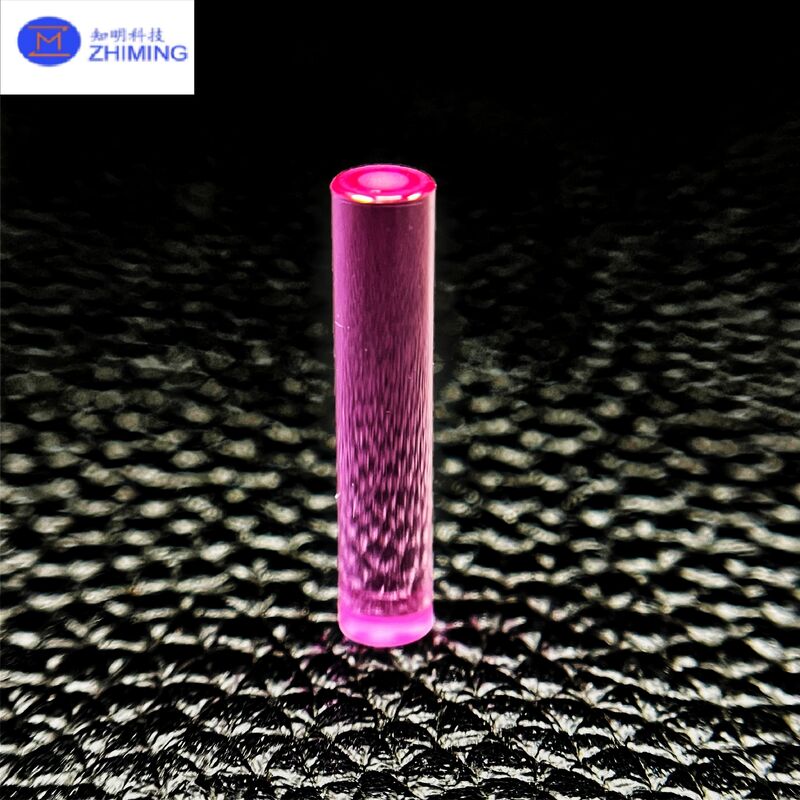
| Nazwa marki: | ZMSH |
| MOQ: | 1 |
| Cena £: | by case |
| Szczegóły opakowania: | niestandardowe kartony |
| Warunki płatności: | T/T |
Ruby Rod is a high-performance single crystal material based on aluminum oxide (Al₂O₃) doped with a controlled amount of chromium ions (Cr³⁺). The chromium dopant gives the crystal its characteristic red color and enables excellent optical and physical properties. As a member of the corundum crystal family, ruby rods offer exceptional hardness, thermal stability, and chemical resistance, making them suitable for both optical and demanding industrial applications.
Ruby rods are widely used in solid-state lasers, optical alignment systems, precision instruments, and wear-resistant components. With precise crystal growth and advanced machining processes, ruby rods can be supplied in various diameters, lengths, crystal orientations, and surface conditions to meet different application requirements.
![]()
Single crystal ruby rods are typically grown using the Czochralski (CZ) or Kyropoulos (KY) method. High-purity aluminum oxide is melted at high temperature, and a carefully controlled amount of chromium oxide is added as a dopant. During crystal growth, chromium ions are uniformly incorporated into the corundum lattice, resulting in excellent optical uniformity and structural integrity.
After crystal growth, the ruby ingots are oriented and precisely cut according to the required crystal axis. The rods are then processed through centerless grinding, fine grinding, and polishing to achieve tight dimensional tolerances and high-quality surface finishes.
![]()
Excellent Optical Performance: Stable optical characteristics in the visible and near-infrared regions
High Hardness and Wear Resistance: Mohs hardness of 9, suitable for precision and high-wear applications
Outstanding Thermal Stability: Maintains performance under high-temperature conditions
Superior Chemical Resistance: Resistant to acids, alkalis, and corrosive environments
High Dimensional Accuracy: Tight tolerances and consistent quality for repeatable performance
Solid-State Laser Systems: Used as ruby laser gain media in pulsed laser applications
Optical Components: Alignment rods, reference rods, and positioning elements
Precision Instruments: Measuring probes, support rods, and mechanical reference parts
Industrial Equipment: Wear-resistant and high-temperature structural components
Research and Laboratories: Optical experiments, material studies, and educational demonstrations
![]()
| Item | Specification |
|---|---|
| Material | Single Crystal Ruby (Cr: Al₂O₃) |
| Dopant | Chromium ions (Cr³⁺) |
| Color | Red |
| Crystal Growth Method | Czochralski (CZ) / Kyropoulos (KY) |
| Crystal Structure | Single crystal corundum |
| Crystal Orientation | C-axis / A-axis / Custom orientation |
| Diameter Range | 0.5 mm – 50 mm |
| Length Range | 5 mm – 300 mm |
| Surface Condition | Polished / Fine-ground / As-grown |
| Surface Roughness | Ra ≤ 0.05 μm (polished) |
| Dimensional Tolerance | ±0.01 mm (tighter tolerances available) |
| Mohs Hardness | 9 |
| Operating Temperature | ≤ 1600 °C (higher for short-term use on request) |
| Chemical Stability | Excellent resistance to acids and alkalis |
Each ruby rod is manufactured under strict quality control procedures to ensure crystal integrity, dimensional accuracy, and consistent performance. The controlled doping process and mature crystal growth technology guarantee stable optical and mechanical properties from batch to batch.
![]()
Q1: What is the difference between a ruby rod and a sapphire rod?
A: Both ruby and sapphire rods are based on single crystal aluminum oxide. Ruby rods contain chromium dopants, which give them a red color and laser gain properties, while sapphire rods are undoped and primarily used for optical windows and structural components.
Q2: Are ruby rods suitable for laser applications?
A: Yes. Ruby rods are classic solid-state laser gain media and are commonly used in pulsed laser systems and research applications.
Q3: Can you supply ruby rods with non-polished surfaces?
A: Yes. Polished, fine-ground, and as-grown surface finishes are available depending on the application.